This article is for informational purposes only. Nothing here constitutes investment advice, a recommendation to buy or sell any security, or a projection of future performance. Investing involves risk, including the potential loss of principal.
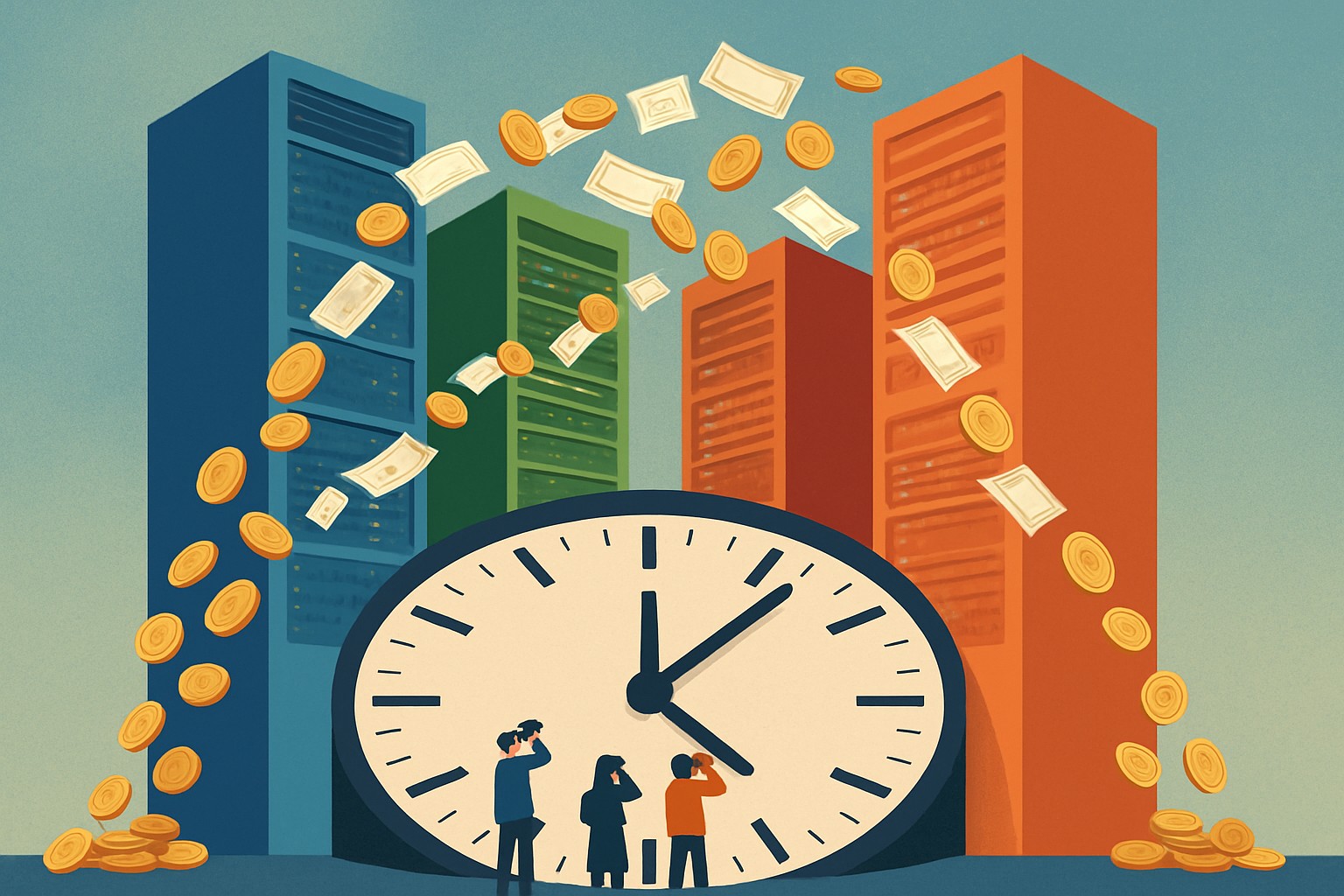
Something changed in 2025 that most AI coverage glossed over: the five largest U.S. hyperscalers stopped funding their AI buildout entirely from internal cash flows and started issuing bonds. Not a little debt — $108 billion in new bonds in 2025 alone. That structural shift is what makes this earnings cycle different from any previous one. The big tech AI capex story is no longer solely an equity story. It’s now a credit story, and the clock runs differently.
The numbers heading into this week’s prints are not in dispute: the Big Five hyperscalers collectively plan to spend $680–720 billion on AI infrastructure in 2026, up roughly 70% from ~$400 billion in 2025. Amazon alone has guided to $200 billion in capital expenditures this year. What is in dispute — and what this earnings cycle is beginning to answer — is whether that spending is producing a revenue machine or a very expensive infrastructure bet with returns still theoretical.
Both cases can be made with real data. That’s the problem, and the opportunity.
What Big Tech AI Capex 2026 Actually Buys (And What It Does Not)
The most cited bearish framing on AI capex comes from Goldman Sachs equity research. The math, as reported by Fortune in January 2026, is straightforward and uncomfortable: sustaining historical returns on an average of $500 billion in annual capex from 2025–2027 would require these companies to generate over $1 trillion in annual profit — more than double the 2026 consensus estimate of roughly $450 billion. Goldman’s Ben Snider put the problem directly: “The magnitudes of current spending and market caps alongside increasing competition within the group suggest a diminishing probability that all of today’s market leaders generate enough long-term profits to sufficiently reward today’s investors.”
Against that backdrop, direct AI revenue remains thin. Combining company-disclosed AI run rates — Microsoft at $13 billion, AWS at $15 billion, plus smaller disclosed segments — total AI-specific revenue across the hyperscalers runs in the range of $30–40 billion annually against capital expenditures in the $680 billion range. The capex-to-direct-AI-revenue ratio remains lopsided. The bull case, and it’s a real one, is that this ratio dramatically understates actual ROI because AI is enhancing product lines whose revenue isn’t classified as “AI revenue.” The bear case is that the ratio reflects a monetization gap that bond markets are now being asked to bridge.
Bank of America’s analysis, reported by 247 Wall St in April 2026, adds another dimension: hyperscaler capex now consumes 94% of operating cash flows after dividends and buybacks. That leaves essentially no margin for error if revenue growth disappoints.
The question isn’t whether AI will eventually pay off. The question is whether it’s paying off on a timeline that justifies the debt being taken on to fund it now.
Microsoft Azure AI: The Enterprise Adoption Test
Microsoft’s FY26 Q2 results offer the clearest window into whether enterprise AI adoption is translating from pilot to production. According to the company’s investor relations press release, revenue hit $81.3 billion (+17% YoY), Azure grew 39%, and commercial remaining performance obligations surged 110% to $625 billion — that RPO figure representing locked-in future enterprise commitments to Azure AI workloads.
A $625 billion backlog is not speculative demand. It’s contracted.
The AI revenue run rate hit $13 billion in Q2 with a stated target of $25 billion by year-end, and Microsoft’s earnings materials noted the company has “built an AI business that is larger than some of our biggest franchises.” The bull case on those metrics is coherent.
The bear case is in the denominator. Motley Fool’s capex analysis from April 2026 distinguishes between companies spending to extend existing moats versus companies spending defensively without equivalent application-layer lock-in. Microsoft, with $29.9 billion in Q2 capex alone, is spending to defend Azure against AWS and Google Cloud while simultaneously trying to pull enterprise customers deeper into Copilot.
The penetration data on Copilot is the metric that cuts through the noise. As reported by Motley Fool in February 2026, fifteen million paid Copilot seats against a 450 million-user commercial base represents 3.3% penetration after two years of availability. That’s not a failed product, but it hasn’t crossed the organizational adoption threshold yet either. Azure growth guided at 37–38% for FY26 Q3, decelerating from 39% in Q2 and 40% in Q1. The trend line matters as much as the absolute number.
The thesis test for Microsoft this quarter: does Azure stabilize its deceleration, and does Copilot seat growth show any acceleration beyond the 15 million figure?
Google Cloud AI Revenue and the Amazon AWS Backlog Case
For the infrastructure-first argument, the cleaner numbers are in cloud.
Google Cloud’s Q4 2025 performance, analyzed by The Diligence Stack, is genuinely striking: $17.7 billion in quarterly revenue, up 48% year-over-year, with a contracted backlog that doubled to $240 billion and operating margin reaching 30.1%. That $240 billion in contracted future cloud revenue is not an analyst projection — it’s money enterprises have already committed. The volume of deals over $1 billion in 2025 exceeded the prior three years combined.
AWS tells a parallel story. According to Futurum Group’s analysis of Amazon’s Q4 FY2025 results, AWS revenue reached $35.6 billion (+24% YoY) — the fastest growth rate in 13 quarters — with an AI-specific revenue run rate of $15 billion annually. Custom silicon, including Trainium and Graviton chips, crossed $10 billion in run rate at triple-digit growth, suggesting the infrastructure investment is generating its own revenue stream independent of workload compute.
Andy Jassy’s stated expectation of “strong long-term return on invested capital” on $200 billion in 2026 capex lands differently when the underlying cloud metrics are accelerating rather than decelerating. The counterargument is that $240 billion in Google Cloud backlog and $15 billion in AWS AI run rate still don’t close the Goldman-identified gap between current capex levels and the profit generation required to justify them. These are fast-growing lines on a balance sheet that still runs negative on the capex-to-AI-revenue calculation.
Fast-growing. Still negative.
Meta AI Advertising ROI: The Shorter Feedback Loop
Meta presents the most unusual capex argument of the four, because its monetization mechanism isn’t cloud contracts — it’s advertising performance, and the feedback loop is shorter.
The official Meta blog post from January 2026 provides the specifics: Q4 2025 ad revenue reached $58.14 billion, up 24% year-over-year. The Advantage+ AI-powered ad suite now runs at a $60 billion annual rate. The GEM model delivered a 3.5% year-over-year lift in ad clicks. Meta Lattice drove 12% improvement in ad quality. Video generation tools crossed $10 billion in run rate.
These are measurable outputs tied to AI investment. Advertisers can measure return on Meta ad spend quarter by quarter. The 24% incremental conversion improvement attributed to Advantage+ isn’t an abstraction — it’s the metric that determines whether brands increase or decrease Meta budgets next quarter.
The complicating factor: Meta’s $115–135 billion 2026 capex guidance includes ongoing Reality Labs spending, which produced $19.2 billion in operating losses in 2025. The AI advertising improvements are real. Whether they justify the full capex envelope — including bets on augmented reality and metaverse infrastructure — is a separate question with a longer time horizon and considerably more uncertainty.
The Debt Clock: Why the AI Infrastructure Spending Timeline Matters
The bond issuance detail deserves more attention than it typically receives in earnings coverage.
When cash flows are sufficient to fund capex, investors are evaluating whether management is allocating capital wisely. When capex is funded through debt, they’re evaluating something different: whether the revenue will materialize fast enough to service that debt before the capital structure becomes a constraint.
The $108 billion raised in bonds in 2025 didn’t happen because these companies ran out of money. It happened because the scale of capex commitment exceeded what free cash flow could absorb while maintaining buyback and dividend programs. The implicit message to debt markets: we’re confident enough in AI revenue to finance construction of the infrastructure before the revenue fully materializes.
That’s a defensible position when borrowing costs are manageable and revenue growth is accelerating. It becomes complicated if cloud growth decelerates, AI adoption remains at 3% penetration rates, or credit markets tighten. None of those scenarios is the base case today. But the presence of debt in the capital structure means the time horizon for the AI payoff thesis is no longer open-ended. Portfolio investors tracking sequence of returns risk in volatile markets will recognize the asymmetry here: the upside is uncapped, but the timeline constraint is new.
What Mag 7 Earnings 2026 Can — and Cannot — Prove
The structural question for portfolio investors isn’t whether this week’s prints confirm or deny the big tech AI capex thesis — one quarter can’t do that. The more useful framing is whether the specific metrics that would indicate meaningful progress are moving in the right direction.
For Microsoft: Copilot seat growth trajectory and Azure stabilization. A one-quarter deceleration is noise. A three-quarter trend is a signal.
For Alphabet and Amazon: cloud backlog conversion rates and AI revenue run rate acceleration. The $240 billion Google Cloud backlog and $15 billion AWS AI run rate are the assets most directly tied to capex justification.
For Meta: Advantage+ revenue growth and advertiser retention data. If AI-driven ad performance continues to compound, the ROI case strengthens independently of the broader infrastructure debate.
These metrics deserve unequal emphasis: cloud backlog and conversion rates are the load-bearing numbers right now, because they’re what debt markets are implicitly being told will service the bonds. The advertising ROI data at Meta is real but structurally different — a shorter feedback loop on a different kind of bet.
The Goldman math remains the external pressure the earnings must eventually respond to. The gap between $450 billion in consensus profit and the $1 trillion needed to justify current capex levels doesn’t close in a single quarter. What closes it — or doesn’t — is the direction of travel across six to eight quarters.
A 2024 BCG survey of 1,000 executives across 59 countries — measuring self-reported organizational capability, not hard ROI outcomes — found that 74% of companies can’t scale AI beyond pilots to extract meaningful returns. That figure comes from enterprise buyers — the same population Microsoft is trying to push past 3.3% Copilot penetration and that Google Cloud is signing $1 billion contracts with. Neither data point cancels the other. They’re both true at the same time.
What the Mag 7 earnings 2026 cycle can show is whether the companies building the infrastructure are finding customers willing to pay for it at scale, and whether that base is growing fast enough to move the AI capex ROI ratio in the right direction. The cloud backlog and run rate data suggests that’s happening — slowly, unevenly, with a debt clock running in the background that wasn’t there two years ago. For a deeper look at how broader market volatility intersects with concentration risk in the tech sector, the Apple CEO transition investor guide covers a parallel set of single-stock risk factors worth reading alongside this analysis.
Sources:
- Big Tech AI Bond Binge (CNBC, Feb 2026)
- Magnificent Seven 2026 AI Capex Plans (Motley Fool, Feb 2026)
- Goldman Sachs: AI Profit vs Capex Gap (Fortune, Jan 2026)
- Is the AI CapEx Trade Cracking? (247 Wall St, Apr 2026)
- Microsoft FY26 Q2 Press Release (Microsoft IR)
- The $720 Billion Capex Trap (Motley Fool, Apr 2026)
- Amazon Q4 FY2025 Results: AWS +24% (Futurum Group)
- Google Cloud AI Capex Measured (The Diligence Stack)
- Meta 2026: AI Drives Performance (Meta Newsroom, Jan 2026)
- BCG: 74% of Companies Struggle with AI ROI (Times of AI)