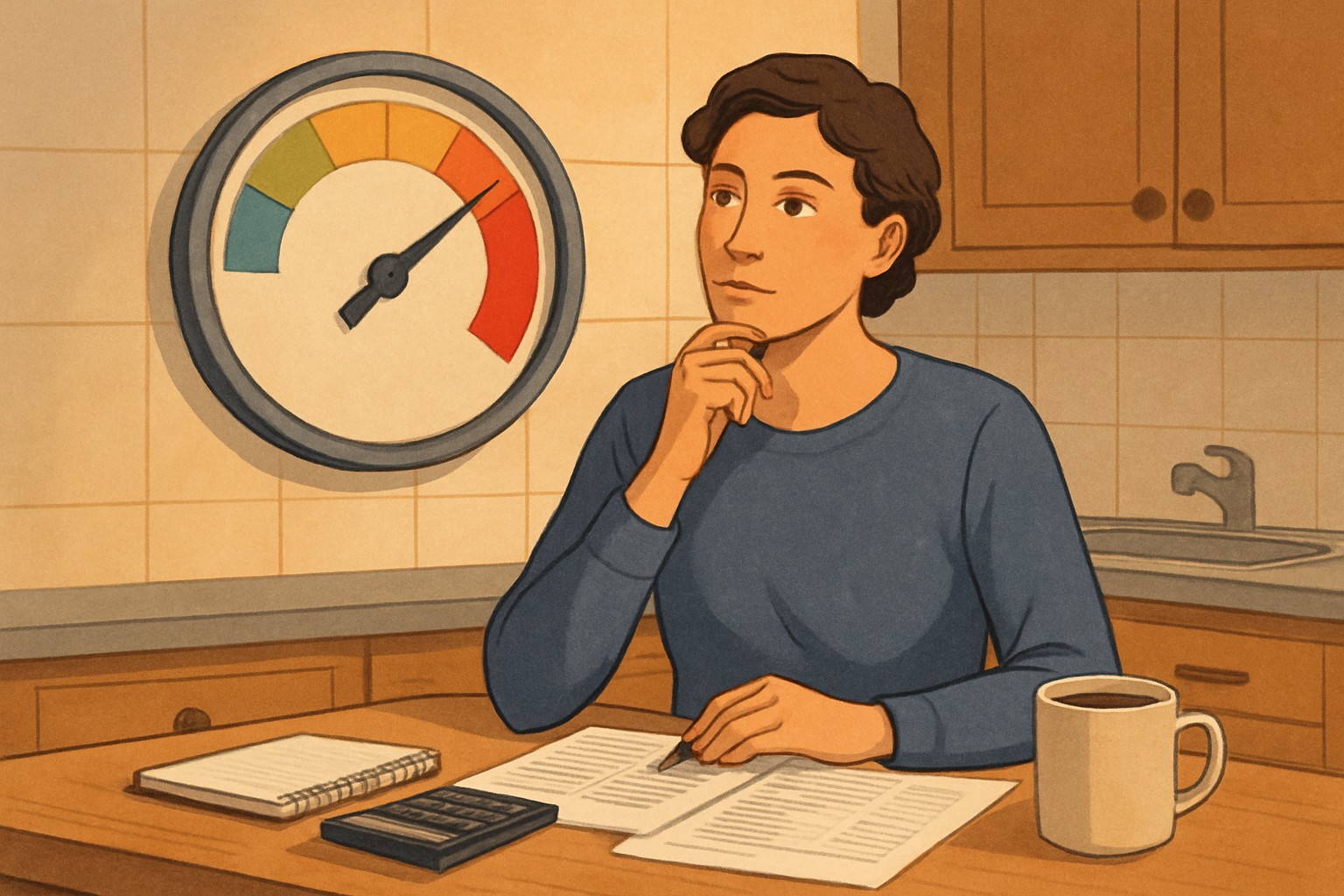
The number everyone is quoting this week is 47.6. That’s where the University of Michigan Consumer Sentiment Index landed in April 2026 — below the 1980 energy crisis, below the 2008 financial collapse, below any reading in the index’s 75-year history. With consumer sentiment at a record low, the headline practically writes itself: Americans have never felt worse about the economy.
But “how Americans feel” and “what a recession actually requires” aren’t the same thing. If you make a major financial move based purely on a sentiment reading, you may be reacting to a fear signal with a pretty poor track record of predicting what you’re afraid of.
That’s not a dismissal. The anxiety is real, and some of the underlying numbers are genuinely concerning. The point is to act on your actual financial exposure, not on an index number, because those two things may not match at all.
Editor’s note: This article is for informational purposes only and does not constitute personalized financial advice. Consult a licensed financial advisor before making changes to your investment strategy or debt repayment plan.
What Consumer Sentiment Record Lows Actually Predict (Not Much)
Here’s the part almost every breathless headline about 47.6 leaves out: the Michigan Consumer Sentiment Index is a notoriously unreliable recession predictor.
Marquette Associates analyzed every sub-60 reading since 1978 and found that such readings coincided with a recession only 33% of the time (2 out of 6 instances). Chad Sheaffer, CFA, CAIA at Marquette put it plainly: “extremely bearish consumer sentiment has historically been a poor predictor of recession.”
Sheaffer’s broader observation is worth sitting with: “Consumer sentiment surveys seem to be far more indicative of the current consumer experience than the longer-term economic outlook.” Translation: the index measures how miserable people feel right now, not whether a recession is coming.
The index is also heavily influenced by things that feel bad but aren’t necessarily economically causal. Marquette’s research shows a strong correlation between the Michigan reading and gasoline prices — a visible and emotionally charged cost that shapes perception even when broader income and spending patterns remain intact.
So when you see 47.6, the honest reading is: Americans are feeling maximum economic pain right now. That’s real, and it matters. What it doesn’t tell you is whether the economy is headed into recession. On that question, the index’s track record is two wins and four losses out of six tries.
Why the Fed’s Own Research Says You May Feel Worse Than You Actually Are
There’s a Federal Reserve FEDS Note that deserves more attention than it’s getting. Researchers found that 43% of respondents reported feeling worse off or much worse off compared to 2019. Troubling, on its face. But when they cross-referenced those same households against verified retail purchase data, those households were actually buying more in inflation-adjusted terms than they were before the pandemic.
People reported hardship while spending more. In real, verified dollars.
The Fed researchers identified why: consumers systematically overestimate inflation. A significant share of respondents believed they’d experienced over 40% price increases when measured inflation was a fraction of that. Separately, many people were working harder (extra jobs, longer hours) to maintain their purchasing power. The effort felt like deterioration even when the outcome held.
This matters because it suggests your gut reading of your own financial situation may be skewed by the same forces distorting the national index. You’ve been paying more attention to prices (because prices are genuinely up). You’ve been working harder to stay in place. That effort reads as stress, and stress reads as financial decline, even when the ledger doesn’t show it.
There’s also a divergence between the two major sentiment indices worth knowing. The Michigan index, which stood at 53.3 in March before dropping to 47.6 in April, is measuring something different from the Conference Board’s Consumer Confidence Index, which read 91.8 in March. The Michigan index asks how people feel about economic conditions; the Conference Board measures assessments of current labor market conditions and near-term plans. The gap between 53.3 and 91.8 is unusually wide, and it suggests the labor market (jobs, hiring, near-term income expectations) is holding up even as emotional sentiment has collapsed.
The labor market data agrees. BLS data for March 2026 shows unemployment at 4.3% with 178,000 nonfarm payrolls added. The Atlanta Fed’s GDPNow model has Q1 2026 growth at 1.3% annualized: decelerating, but positive.
None of this means the risk is zero. It means the fear and the facts are not in perfect alignment.
The Real Numbers That Do Warrant Concern
I’m not going to pretend everything is fine. Some of the actual financial numbers warrant real attention, and I’d rather you hear them plainly than stumble across them in a panic headline.
Total credit card balances hit $1.277 trillion in Q4 2025, a record. The personal savings rate in February 2026 was 4.0%, roughly half the long-run average of 8.4%. Bankrate’s 2026 emergency savings report found that 59% of Americans can’t cover a $1,000 emergency, and 24% have no savings at all.
And the recession probability estimates from major institutions aren’t dismissible: Goldman Sachs at 30%, JPMorgan at 35%, Moody’s Analytics economist Mark Zandi near 49%. Those are not fringe forecasts. Somewhere between a coin flip and a one-in-three chance is a reasonable range to hold in your head. Not certainty. But not nothing.
Year-ahead inflation expectations jumped from 3.8% to 4.8% in a single month, per the Michigan survey. And Wells Fargo’s 2026 Money Study found that 57% of Gen Z respondents would exhaust their funds in under three months after a job loss.
So the honest picture: the fear index is probably overstating the macro risk, but the underlying personal finance fundamentals for many households are genuinely thin. A 30-49% recession probability is worth preparing for. It’s just not worth panicking over.
Your Recession Money Playbook: Two Starting Points, Two Different Moves
Here’s where most generic recession articles fall apart. They assume everyone starts from the same place. You don’t, and blanket advice tends to serve the people who need it least.
Your next move depends on where you actually are.
If You’re Already Stretched: Build a $500 Floor First
If you’re carrying a credit card balance, have less than one month of expenses saved, and your paycheck is mostly spoken for before it arrives, the goal right now is stability. Not optimization. Not six-month emergency fund targets that feel like a joke from your current position.
Start with $500 to $1,000. The Bankrate data shows 59% of Americans can’t cover a $1,000 emergency, so if you can get there, you’re already ahead of the majority. High-yield savings accounts are currently paying in the 4-4.5% range (rates are variable and change with Fed policy, so confirm current rates before opening an account), meaning money held there earns something while it sits. (For a full breakdown of current rates and how to choose between an HYSA and a CD, see our guide to locking in high-yield savings rates before the Fed cuts.)
Before you can save anything useful, though, you need to know your minimum viable number: if you lost your job tomorrow, what’s the floor? What’s the minimum each month to cover rent, utilities, and food? Write it down. That number tells you how much runway your savings actually represents, and having it written down is less scary than the vague dread of not knowing.
Then look hard at recurring charges. Not to deprive yourself, but to find what’s on autopay that you’ve genuinely forgotten about. Streaming services, subscription apps, gym memberships collecting digital dust. EY-Parthenon’s April 2026 consumer study found that 27% of households had already cut entertainment and restaurant spending. If that’s you, make sure the cuts are intentional, not just random financial bleeding.
If You Have Some Breathing Room: Extend Your Cushion, Not Your Risk
If your emergency fund covers at least two months of expenses, you’re not carrying high-interest debt, and your income is stable, the risk isn’t that your finances are fragile. The risk is that fear pushes you into moves that actually hurt you.
The biggest one: don’t move investments to cash. The instinct to “get safe” during a sentiment panic is expensive. History is consistent here. People who exit equities during sentiment crashes lock in losses and miss the recovery. If your allocation felt right three months ago, a consumer sentiment record low of 47.6 isn’t new information about your portfolio.
What is worth doing: extend your emergency fund toward six months. If you’re already at two or three months, adding to it now makes sense (not because recession is certain, but because the 30-49% probability range justifies slightly more cushion). Park additions in a high-yield savings account rather than a CD if you want to keep the money accessible.
What counts as the right allocation depends on your life stage: someone within five years of retirement is in a materially different position than someone with 20 years of runway, and your comfort with short-term volatility should reflect that. If you’re unsure how your current allocation matches your timeline, a fee-only financial advisor can help you assess it.
And the most underrated move in this environment? A career audit. Is your employer vulnerable to a slowdown? Do your skills transfer if your industry contracts? Updating your resume, reconnecting with your network, picking up a complementary credential — all of it costs nothing and pays off whether or not a recession ever arrives.
The One Move That Pays Off Either Way: Pay Down High-Interest Debt
Whether a recession arrives or not, reducing high-interest credit card debt is the closest thing to a guaranteed return in personal finance.
Average credit card APRs are currently above 20%. Paying down a 22% APR card is a 22% return on every dollar: risk-free, no market dependency required. With $1.277 trillion in balances outstanding nationally, high credit card debt is also the most common financial vulnerability going into a potential downturn. Balances that feel manageable now can become existential when income drops and minimum payments don’t shrink with it.
If you have multiple balances, the math favors paying the highest-rate card first (the avalanche method). If the math alone doesn’t motivate you, pay the smallest balance first for a quick win (the snowball method). Either approach beats making minimum payments on everything and waiting to see what happens.
And if you’re also navigating retirement contribution decisions before April 15, our breakdown of which IRA to fund first lays out the tradeoffs by income situation.
What to Stop Doing Until the Picture Clears
Fear-driven financial moves have a cost. A few of the ones most likely to hurt you right now:
Moving investments to cash. Sentiment-driven market exits consistently underperform a held position. If your allocation matched your actual risk tolerance before the headlines got loud, it still matches now. The headlines aren’t new information about your portfolio; they’re noise.
Making major illiquid purchases to front-run inflation. Tariff anxiety is pushing some households toward large purchases they can’t really afford, on the assumption that prices will be even higher later. That logic may be true for some categories, but taking on debt to front-run inflation means gambling with your financial stability. Some of those bets will pay off. Some won’t. That’s the part the logic usually skips.
Reading “sentiment is unreliable” as “nothing bad can happen.” It can. A 30-49% probability isn’t nothing. Calibrate to the actual range rather than to either extreme.
Measuring yourself against national averages. The 59% emergency fund gap and the $1.277 trillion in credit card debt are real aggregate numbers; they don’t describe your situation specifically. Your starting point is your starting point.
The practical truth about a 47.6 consumer sentiment reading: it tells you people are scared, which is real information about psychology and about the lived experience of higher costs. It doesn’t tell you what your specific financial situation requires. Get clear on your own numbers first, then act on those. That’s not a platitude. For most people, it’s the only move that actually makes sense right now.
This article is for informational purposes only and does not constitute personalized financial advice. Recession probability estimates, economic data, and savings rates change frequently — verify current figures before making financial decisions. Consult a licensed financial advisor before acting on any information in this article.