This article is for informational purposes only and does not constitute investment advice. Consult a licensed financial advisor before making any investment decisions.
Before the financial analysis: the 2026 Iran conflict has cost lives and displaced civilians on a significant scale. Markets reduce that to a price signal. That reduction is analytically necessary but worth naming before proceeding.
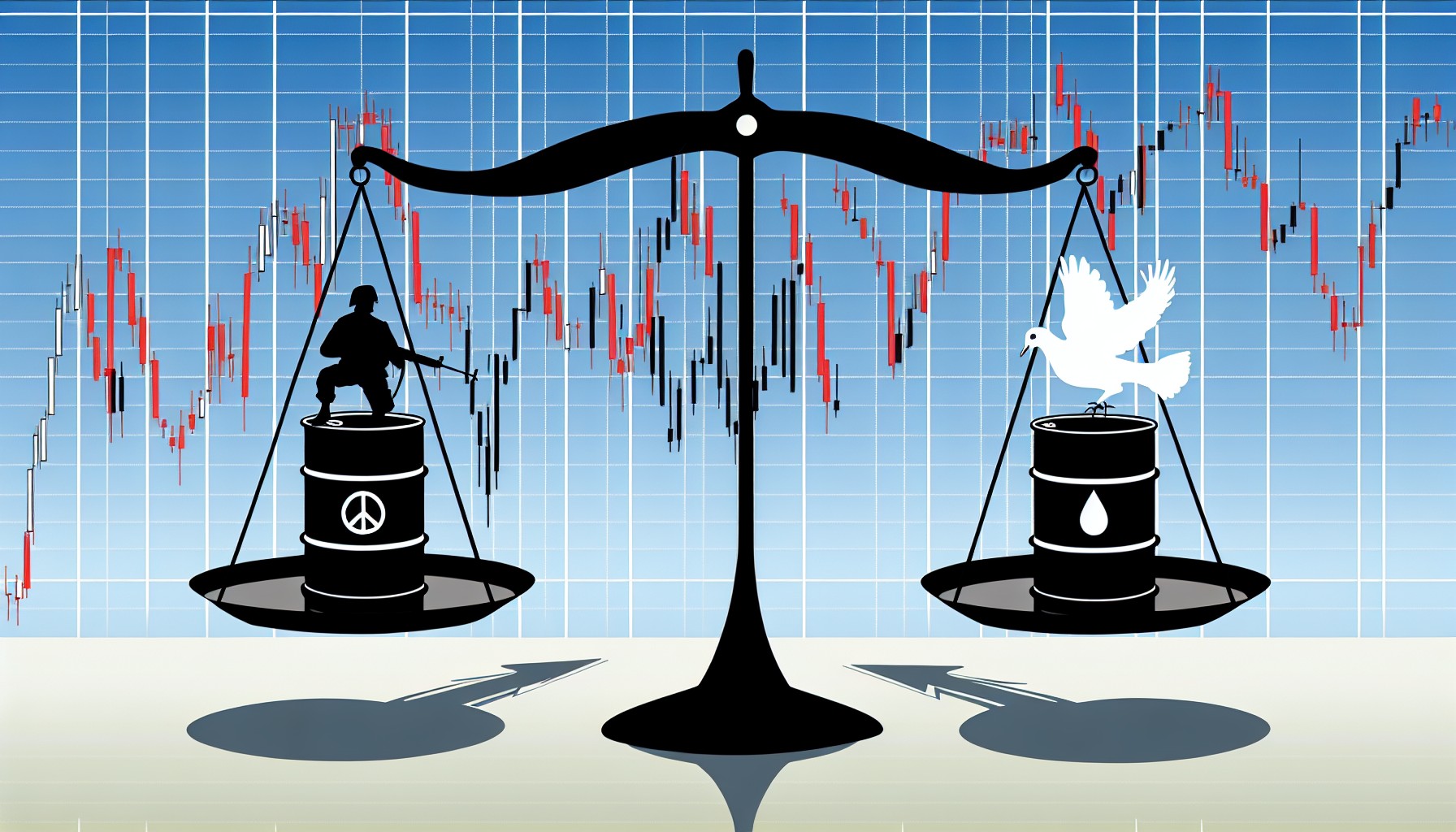
If you hold XLE, XOP, or OIH right now, you’re not just holding energy exposure. You’re holding a geopolitical opinion — and Goldman Sachs has put a dollar figure on it.
Daan Struyven, Goldman’s Head of Oil Research, put it plainly: “With the market price at $78, the market is essentially pricing an $13 per barrel risk premium.” That was early March, when Brent was trading around $78. Since then, Brent spiked to roughly $120 at its mid-March peak before retreating to $101 on April 1 as de-escalation signals emerged. Given Brent’s move from $78 to $101, Goldman’s own fair-value model implies the premium has expanded well beyond the original $13/barrel estimate. The question for energy ETF holders is simple and uncomfortable: how much of your gain is real, and how much evaporates the moment negotiations succeed?
What ‘War Premium’ Actually Means — and Why $13 Is the Number That Matters
A war premium is the gap between what oil would trade at under normal supply-demand conditions and what the market’s actually paying to account for disruption risk. Goldman’s model puts fair value at roughly $65/barrel without the energy ETF war premium. At the March $78 price, that $13 gap represented roughly a sixth of the barrel’s value. At current $101 levels, the implied premium has grown to more than a third — a material increase in geopolitical exposure that most energy ETF holders haven’t actively priced into their positions.
The anxiety has structural grounding. The Strait of Hormuz carries approximately 20 million barrels per day — roughly 20% of global petroleum liquids. The EIA puts total bypass capacity at a fraction of that: roughly 2.9 million barrels per day through existing pipeline alternatives. If the strait is closed or even partially constrained, there’s no redundant pathway that handles the volume. That physical constraint is what separates Iran 2026 from most prior geopolitical episodes.
The CSIS assessment noted that Gulf production had already been cut by more than 10 million barrels per day by March 12. Adi Imsirovic, Senior Associate at CSIS, observed that “risk was accumulating before the first shot was fired” — a reference to the months of posturing and sanctions escalation that pre-positioned markets for disruption before open conflict began. The risk isn’t imaginary. It’s priced into every barrel you’re holding.
The Energy ETF Bear Case: What 1991 Tells Us About the Day Peace Breaks Out
The 1990-91 Gulf War is the cleanest historical comparison, and it’s not comforting for current energy ETF longs. Oil ran from roughly $17/barrel to $46 — a 171% spike — on fear of Saddam’s invasion and its implications for Saudi supply. The moment the air war began on January 17, 1991, the market concluded the risk was being actively contained. Oil dropped $10.56 in a single session. By March 1991, Brent had fallen 31% from its peak. The S&P 500 gained 13.6% in the same window — a textbook “buy the invasion, sell the anticipation” outcome.
The logic was the same then as now. War premia are priced on the possibility of disruption. Once the market gets resolution — in either direction, including a ceasefire — that probability collapses faster than the underlying supply picture changes. The RBC Wealth Management equity strategy team has framed the key question with appropriate precision: “The key issue is not whether there is a short-term spike in oil prices. What’s more relevant to stocks…is whether a sustained impact to oil prices is seen.”
In 1991, the answer was no. Energy equities gave back most of their conflict-period gains within three months.
The BofA Ukraine analog extends the point. Bank of America analysts concluded that Brent could drop $5-10/barrel simply from the prospect of Russian barrels no longer needing rerouted supply chains — before a single barrel of supply actually changed hands. War premium unwinds fast, and it doesn’t wait for the physical picture to normalize.
For XLE and XOP holders, the arithmetic is stark. Goldman’s $13/barrel baseline premium was calibrated when Brent was at $78. At $101, the implied premium has expanded. A return to fair value — call it $65-75 — would represent a 25-35% decline in the commodity driving energy company cash flows. XLE is up 33% YTD. XOP is up 41%. A significant portion of those gains may be premium, not fundamental value creation.
The Bull Case: Why This Conflict Is Structurally Different From Every Prior Precedent
The bear case assumes a clean resolution. There are serious reasons to question whether one is coming.
Start with the bypass capacity gap. In 1991, Saudi Arabia and other Gulf producers were largely insulated from the conflict and ramped production to compensate for Kuwaiti disruption. Today, Saudi Arabia and UAE have constrained output under OPEC+ agreements, and the strait itself is the choke point — not a single producer’s infrastructure. There’s no production switch to flip. The EIA’s Hormuz analysis makes clear that bypass alternatives — the IPSA pipeline, the UAE’s Habshan–Fujairah pipeline — handle roughly 2.9 million barrels per day combined. The strait carries 20 million. That 17-million barrel gap isn’t closeable in any realistic near-term scenario.
Second, the IEA has already deployed 400 million barrels from strategic reserves — a record release. The U.S. SPR sits some 200 million barrels below its pre-2022 levels. The conventional policy backstop is materially diminished compared to any prior conflict. As the Motley Fool’s April 4 analysis observed, the combination of strategic reserve drawdowns and structural bypass limitations creates a supply environment with less cushion than markets faced in 2003 or 2011.
Third — and this is the point the 1991 analog understates — Iran’s oil infrastructure doesn’t come back online in weeks. In Libya in 2011, a 1.6-million barrel-per-day disruption took 12 months for full restoration, and the premium persisted well beyond the ceasefire date. Iran represents a substantially larger supply variable. A negotiated settlement doesn’t automatically mean supply restoration; it means supply possibility, and those are different things with different price implications.
The economic impact analysis reflects this structural distinction — the 2026 conflict’s disruption mechanics differ materially from the 1991 template the bear case relies on. Struyven himself noted that “to generate substantial demand destruction, prices may have to rise into triple-digit territory.” That observation cuts both ways: upside could extend further before demand destruction caps the rally.
XLE vs. XOP vs. OIH: Which ETF Carries More War Premium Risk
Not all energy ETFs carry the same exposure to a war premium unwind. Composition matters.
XLE (Energy Select Sector SPDR) is weighted heavily toward integrated majors — ExxonMobil, Chevron, ConocoPhillips. Integrated majors carry diversified revenue streams: refining, chemicals, LNG trading. They’re natural hedges against commodity price volatility within the energy complex. XLE has returned +33.34% YTD.
XOP (SPDR S&P Oil & Gas Exploration & Production) is pure upstream — E&P companies with direct leverage to the commodity price. No refining margin to cushion a drop. XOP has returned +41.33% YTD, meaningfully ahead of XLE, which is consistent with its higher beta to oil. The premium math hits XOP hardest in a downside scenario.
OIH (VanEck Oil Services ETF) carries a different exposure altogether — oilfield services companies whose revenues depend on drilling activity, not commodity prices directly. At +39.43% YTD, OIH’s gains partly reflect expectations of sustained capital expenditure from producers. Services companies are somewhat insulated from a short-term commodity dip if producers maintain drilling programs, but they’re not immune if a price decline triggers capex cuts.
The hierarchy of war premium exposure, from most to least: XOP → OIH → XLE. A rapid de-escalation scenario hits XOP hardest and XLE least badly, simply by composition.
If you’re thinking about ETF risk in the context of a single macro thesis — not just the energy sector — the same structural question applies to thematic funds exposed to geopolitical variables. For a look at how ETF composition affects exposure in tech-driven macro bets, the ARK ETF breakdown on OpenAI exposure illustrates how fund structure shapes your actual risk, not just your stated position.
The Position-Sizing Question: How Much War Premium Can You Afford to Lose?
This is the question most energy ETF analysis sidesteps.
If Goldman’s fair value without the premium is roughly $65/barrel, and Brent at this writing is around $101, you’re carrying somewhere between $36 and $50/barrel of price that requires the conflict — or at minimum its uncertainty — to persist. No one knows how long that persists. Binary outcomes are rarely as clean as they look. A partial ceasefire, a negotiated reduction in hostilities, a U.S.-brokered deal that leaves Iranian nuclear questions unresolved — all of these produce partial premium unwinding, not the full $10.56-in-a-day 1991 scenario.
The RBC framework is useful here: the question isn’t whether there’s a spike, but whether there’s a sustained supply impact. If there is, the premium persists. If there isn’t, it doesn’t.
The practical sizing question is what percentage of your portfolio’s value is sitting in war premium. For a holder of XOP specifically, a 25% decline in oil prices from current levels — consistent with a partial unwind toward $75 — could translate to a 30-40% drawdown given XOP’s commodity beta. A 10% XOP allocation becomes a 3-4% portfolio hit in that scenario. Not catastrophic. But it needs to be a deliberate decision, not a passive one.
Two Scenarios, One Portfolio: A Framework for Holding Energy ETFs in a Binary Market
Resist the urge to call the outcome, and size for both scenarios.
Scenario A — Prolonged disruption: Hormuz remains contested. Iranian production stays offline. OPEC+ members can’t or won’t offset. Brent sustains above $90-100. XOP’s commodity beta continues to work in your favor. The bear scenario never materializes because the supply picture never normalizes.
Scenario B — Rapid de-escalation: Negotiations succeed, or U.S. military action achieves a decisive outcome that eliminates the uncertainty. Iran de-escalation reintegrates 1.5-2 million barrels per day of supply. OPEC+ cuts below $80 to defend price. The war premium collapses in days, not weeks. XOP gives back a substantial portion of its 41% YTD gain.
It happened in 1991. The mechanism is well-documented. It can happen now.
Anyone who presents Scenario A as the base case without rigorous acknowledgment of Scenario B is selling a narrative. The Goldman $13/barrel figure is useful precisely because it’s quantified — a concrete number to stress-test against your own risk tolerance, rather than an abstract assertion that “energy could be volatile.”
Holding energy ETFs right now embeds a specific geopolitical assumption. The conflict persists and the disruption is real. The decision to maintain, reduce, or add to that position should be made with clear understanding of what that assumption actually is — and what the data shows about how fast the market can reprice the energy ETF war premium the moment it changes.
Sources
- Goldman Sachs war premium analysis via Fortune (March 2026)
- MarketMinute: Brent slides on Iran de-escalation (April 1, 2026)
- CSIS: What Does the Iran War Mean for Global Energy Markets
- EIA: Strait of Hormuz — World’s Most Important Oil Chokepoint
- Motley Fool: Why Oil Prices Are Surging and What a Strait Closure Means (April 4, 2026)
- RBC Wealth Management: Market Reactions to Military Conflicts
- OilPrice.com: BofA on Ukraine ceasefire and Brent
- Wikipedia: 1990 Oil Price Shock
- Wikipedia: Economic Impact of the 2026 Iran War