Some links in this article are affiliate links. We may earn a small commission at no extra cost to you.
Most spring home-maintenance checklists assume you own a 24-foot extension ladder and are comfortable hauling it around your roof line. A lot of homeowners aren’t — and that’s not a character flaw. Age, a past fall, acrophobia, or simple risk calculation can all lead to the same reasonable conclusion: I’m not doing that.
What those checklists almost never cover is what to do instead.
Here’s the playbook for the rest of us. Five spring home maintenance tasks that typically require elevation — gutters, roof inspection, windows, exterior paint and siding, debris clearing — all mapped to ground-level workflows, with real product names and honest pro-hire triggers when the ground-level approach genuinely isn’t enough.
Why Doing Spring Maintenance Without a Ladder Is a Valid Strategy
The injury math on residential ladder use is not great. According to the CDC/NIOSH, ladders send more than 500,000 people to treatment annually in the U.S. and kill approximately 300. And 97.3% of those accidents happen in non-occupational settings — homes and farms — not job sites with trained workers following safety protocols.
Height intolerance is more common than most people admit. Research published in PMC (NIH, 2020) estimates that 2–5% of the general population has clinical acrophobia, with up to a third of people experiencing some degree of visual height discomfort. If you’ve ever frozen on a ladder at the third rung, you’re not alone — and you’re not obligated to push through it.
The tools available for ground-level home maintenance have genuinely improved. Here’s how to get through the full spring exterior list without leaving the ground.
Task 1: Gutter Cleaning Without a Ladder
Gutters are the task that sends the most homeowners reluctantly up a ladder every spring. They don’t have to be.
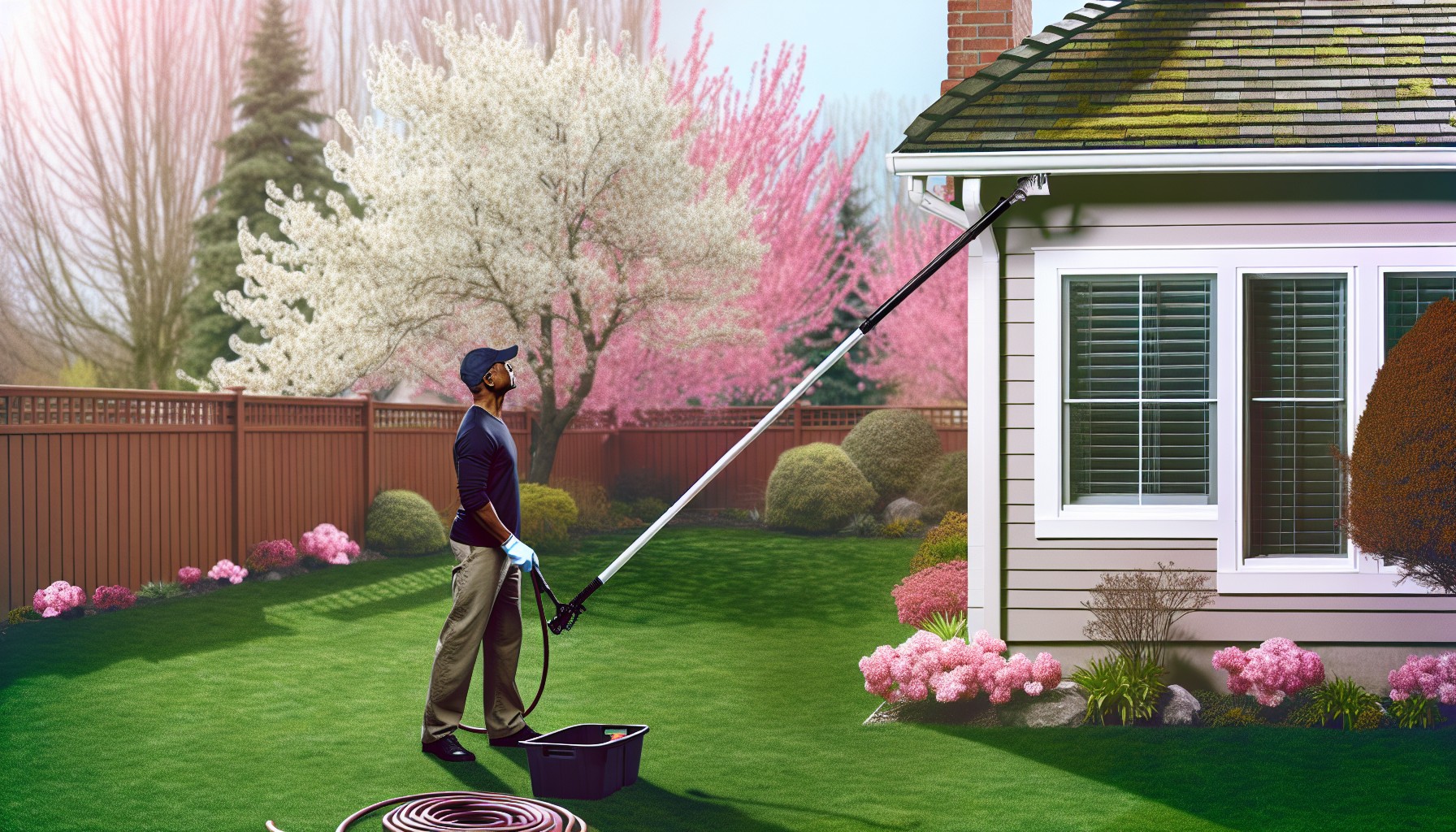
Garden hose attachments are the easiest entry point. The Orbit Telescoping Gutter Cleaning Wand attaches directly to your garden hose and extends 40–70 inches, pushing debris down the gutter channel with water pressure. It works well for standard single-story gutters and for clearing loose leaf accumulation before it compacts.
→ Check current price on Amazon
Leaf blower attachments step up the reach. The WORX GUTTERPRO WA4094 is an 11-foot kit designed to hook over the gutter lip from below — no ladder contact required. It works with most WORX blowers and blasts dry debris outward. One limitation: wet, compacted debris won’t budge with air alone, and the 11-foot reach tops out at about one story.
→ Check current price on Amazon
Wet/dry vac kits handle the heavy stuff. The Craftsman 4-piece Wet/Dry Vac Gutter Cleaning Kit extends your shop vac’s reach to about 47 inches — suited for single-story gutters where you can angle the nozzle over the lip without climbing.
→ Check current price on Amazon
Look, all three of these tools top out at around one story for reliable results. Two-story gutters with significant debris buildup? Ground-level tools get awkward fast. Professional gutter cleaning runs $119–$234 nationally, with a typical cost around $168. That’s not an unreasonable annual line item for avoiding an ER visit.
Victor Sedinger, Certified Home Inspector at House Exam Inspection and Consulting, writing for Family Handyman, puts it directly: “Clogged gutters and downspouts can cause the wood trim at the eaves to rot, and that can invite all kinds of critters into your attic space.” If the ground-level tools aren’t cutting it, hire it out — that’s not a failure, it’s a spending decision.
Task 2: Roof Inspection From the Ground — What You Can Actually See
Most homeowners assume a spring roof inspection means someone walking the roof. It doesn’t.
Sedinger says plainly: “It doesn’t require a ladder, and you certainly don’t have to get on a roof to look.” A ground-level inspection using binoculars or your smartphone’s telephoto lens reveals missing or lifted shingles, visible flashing damage, and granule loss — the main indicators that something needs attention.
What to look for from the ground:
- Missing or curling shingles — edges lifting or tabs missing, especially at ridge lines and valleys
- Dark streaking or staining — algae growth, often appearing as black lines running down the slope
- Flashing condition around chimneys and vents — separated or rusted metal is a leak risk
- Visible sagging in the roofline — the most serious indicator, meaning structural concern
If your ground view is blocked by overhangs or angles, drone inspection is the next-tier option. Professional drone roof inspections run $150–$400 nationally, and many roofing companies now offer them as a standard service. You get high-resolution aerial photos without anyone on the roof — including you.
Here’s the thing about visual inspections, even drone ones: they can’t confirm the condition of underlayment, decking, or flashing seals. If you spot anything that looks like active damage, the follow-up is a licensed roofing contractor — not another inspection from a different angle.
Task 3: Window Cleaning and Sealing From the Ground
Upper-floor window cleaning is genuinely doable from the ground with the right tool category: extension poles with squeegee and scrubber attachments.
The DocaPole 6–24 Foot Extension Pole Kit gives about 17 feet of working reach — enough to cover most two-story exterior windows when you account for arm extension. It handles a squeegee, scrubber, and mop head, and the adjustable angle attachment lets you hit the glass at a real cleaning angle rather than just scraping vertically.
→ Check current price on Amazon
If the DocaPole’s 17-foot practical limit falls short of your upper-story sills, the EXTEND-A-REACH 12ft Squeegee Kit advertises up to 20 feet of reach.
→ Check current price on Amazon
Caulk inspection around upper-story window frames is also a ground-level job — done with binoculars. Cracked or separating caulk is visible at a distance. Flag any gaps for a pro when they’re already on site for another task.
Task 4: Exterior Paint Touch-Ups and Siding Check
Walk the perimeter. Scan for peeling or chalking paint, check caulk joints at trim lines and corners, and probe any soft or discolored wood with a screwdriver. If it sinks in, you’ve found rot.
For paint touch-ups below the first-floor eave line, a standard extension pole for a paint roller handles most patching jobs. Keep a quart of your siding color on hand specifically for spring touch-up season.
→ Check current price on Amazon
Upper-story paint and siding? Hire it out. No extension roller reaches cleanly to second-story eaves, and the prep work — scraping, priming — requires close access that ground-level tools can’t replicate. If you find soft siding or rot at height during your binocular scan, that’s a contractor call. Catching it early is the win. Not trying to fix it yourself from an awkward angle.
Task 5: Clearing Roof and Gutter Debris Without Climbing
Spring roof debris — pine needles, seed pods, branches that landed over winter — collects in valleys and flat sections where it holds moisture against roofing material. Getting it off matters.
For gutters, the tools from Task 1 apply. For debris on accessible low-slope sections visible from below, a pressure washer wand with long telescoping reach is the highest-powered ground-level option.
The VEVOR 20FT Telescoping Pressure Washer Wand reaches the equivalent of two stories and adjusts in sections. Amazon reviewers report it handles compacted gutter debris and can direct water into downspout openings to clear clogs. One caution: high-pressure water aimed at a roof slope can force water under shingles if you point uphill into the overlap. Aim with the shingle direction, not against it, and use a lower-pressure nozzle on roofing material.
→ Check current price on Amazon
The long game: gutter guards. If you’re tired of this task every season, a micro-mesh gutter guard system addresses the root problem. A 2025 This Old House survey found that 30% of owners with gutter guards reported never cleaning gutters after installation, with another 41% reducing to annual cleaning. Professionally installed micro-mesh systems run $3,000–$7,000 depending on home size — not cheap, but a permanent upgrade to the annual gutter scramble.
When to Hire a Pro: Ground-Level Has Limits
Ground-level workflows cover the majority of spring home maintenance. Here’s where the professional hire stops being a backup option and becomes the right answer:
- Gutters: Two-story or higher with significant compacted debris buildup, or if the ground-level tools didn’t fully clear the channel. Professional cleaning: $119–$234. Just book it.
- Roof: Any visible structural damage, sagging, active leaks, or anything you can’t clearly evaluate from the ground. Get a drone inspection ($150–$400) before calling a contractor — the photos give them something to quote from.
- Windows: Interior seals failed (fogging between panes), wood rot at frames. A window glazer or handyman handles both without requiring scaffolding.
- Paint and siding: Any rot, any upper-story work, or if your ground-level inspection revealed more than touch-up-scale damage. Get bids from two or three local painters in spring before their season books solid.
- Debris: Heavy winter-damage debris or anything the pressure wand won’t budge. Most gutter services include roof-debris clearing.
The bar shouldn’t be “can I physically manage this with the right tool.” It should be “is this tool the right answer for this situation.” Sometimes the right answer is a $150 drone flight and a $200 gutter cleaning — and you still finished your spring checklist without ever leaving the ground.
That’s just good risk math.
Sources
- CDC/NIOSH Ladder Safety Bulletin 2017
- Ladder Safety Statistics — Little Giant Ladders Blog (AJPM 2007 data)
- Visual Height Intolerance and Acrophobia — PMC/NIH 2020
- Victor Sedinger quotes — Family Handyman Spring Home Maintenance Checklist
- Drone Roof Inspection Cost — HomeGuide 2026
- Gutter Guards Survey — This Old House 2025
- Professional Gutter Cleaning Cost — HomeGuide 2026