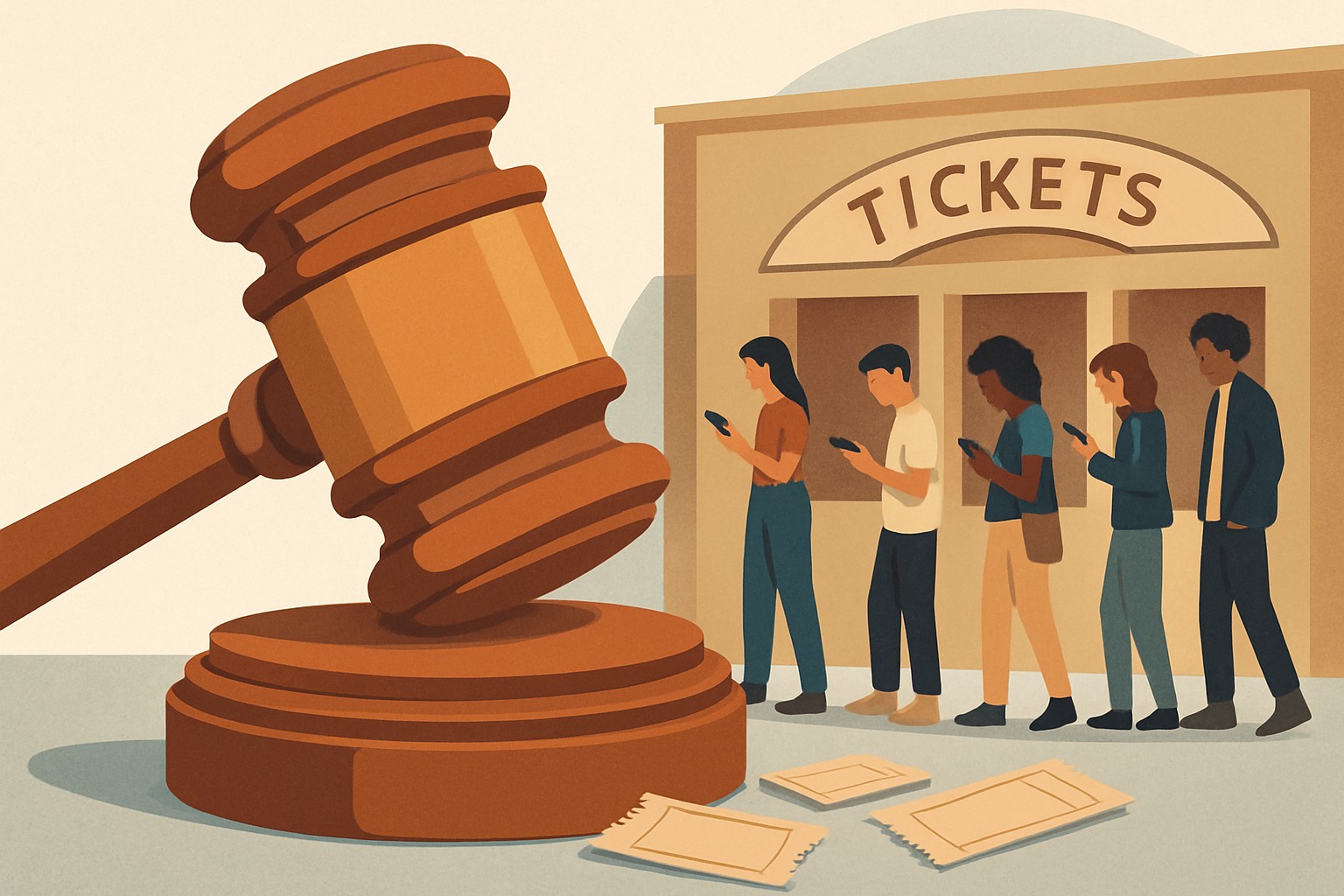
The biggest consumer protection verdict in live music history landed today. The Ticketmaster verdict on concert tickets arrives just months after the FTC banned hidden “order processing fees” — and reporting on documents from 26 venues found that Ticketmaster quietly raised its per-ticket service charges to recover exactly what it lost. According to that reporting, per-ticket service charges were raised to offset the revenue lost under the FTC order. That’s the sharpest possible summary of why a jury verdict, on its own, doesn’t automatically lower your ticket costs.
So here’s the useful part.
The Ticketmaster Verdict Is Real. So Is the Fee-Shifting.
On April 15, 2026, a Manhattan federal jury found Live Nation and Ticketmaster liable on all counts of illegally maintaining monopoly power in the concert ticketing market and in large amphitheaters. Thirty-four states and Washington, D.C. brought the case. Four days of deliberation after a five-week trial. Not a close call.
New York Attorney General Letitia James put it plainly: “For far too long, Live Nation and Ticketmaster have taken advantage of fans and artists by raising prices for tickets and stifling any competition that threatened their power.” California AG Rob Bonta called it a “historic verdict.”
Live Nation’s response: “The jury’s verdict is not the last word on this matter. Pending motions will determine whether the liability and damages rulings stand.”
That’s an accurate description of how antitrust law works, not spin. The remedies phase hasn’t started. No structural changes are in effect. And Ticketmaster controls 86% of concert ticketing at major venues and 73% of all event ticketing. Nowhere else to go unless you know where to look — and there are actually places to look.
The $1.72 Figure and What It Doesn’t Tell You
The headline damages number is $1.72 per ticket. That’s the amount the jury found Ticketmaster overcharged consumers, but only in 22 states that are party to the damages phase of the case. Under the Clayton Act, antitrust damages can be trebled, putting potential liability around $450 million.
The $1.72 sounds small. The fee structure behind it isn’t. The FTC’s September 2025 complaint documented that consumers spent $82.6 billion on Ticketmaster tickets between 2019 and 2024; $16.4 billion of that was mandatory fees averaging 27 to 34% of face value, sometimes reaching 44%.
The $1.72 reflects what the jury determined was the demonstrable overcharge attributable to monopolistic conduct in those 22 states. The broader fee structure is a separate issue from what the jury was asked to quantify. John Newman, former FTC economist, has observed that Ticketmaster may effectively still be charging the same fees under different labels. The fee-shifting behavior at those 26 venues after the FTC order is exactly what he’s describing.
Do not expect a refund check. There’s no confirmed distribution mechanism. The remedies phase will determine how, or whether, damages get distributed to consumers at all.
What the DOJ Settlement Already Changed for Concert Fans
Before the states took Live Nation to trial, the Trump DOJ settled separately with Live Nation on March 9, 2026. That deal included a 15% fee cap at venues Live Nation owns, operates, or controls, divestiture of 13 exclusive booking agreements, and an open-platform requirement. The 34 states also established a $280.4 million settlement fund as part of the broader resolution. The DOJ’s fee cap is already technically in effect.
The 34 states rejected the DOJ settlement as insufficient and continued to trial. They were right to push: the settlement covers only Live Nation-controlled amphitheaters, which is meaningful but a narrow slice of the market. Live Nation controls 78% of large amphitheaters in the U.S., so even “owns, operates, or controls” leaves most of the ticketing market untouched.
The DOJ deal also required an open-platform condition that could allow rival ticketing companies to list on Ticketmaster’s infrastructure. That hasn’t produced visible competition yet, but it’s the mechanism worth watching.
If you’re buying tickets to a show at a Live Nation-owned venue, the 15% fee cap is already law. If you’re buying at an independently owned venue that simply uses Ticketmaster’s software, you’re back to the full fee structure.
What Concert Ticket Alternatives Actually Cost Right Now
The practical question is whether alternatives exist. They do, and the numbers are real.
Ticketmaster’s fees average 27 to 34% of face value based on the FTC complaint data, occasionally hitting 44%. On a $75 concert ticket, that’s $20 to $33 in fees before you check out.
AXS averaged 19.6% in fees on its resale marketplace in New York, per a 2025 NITO report. AXS primary ticketing fees run closer to Ticketmaster’s range, but the resale gap matters if you’re buying secondhand. On a $100 resale ticket, the difference between 19.6% and Ticketmaster’s typical 27 to 34% is $7 to $14 back per ticket. Real money for anyone buying two or four.
DICE runs a no-resale model with transparent upfront pricing. The platform is popular with independent and smaller-venue artists who opt into its ecosystem. You won’t find arena acts there, but for mid-size venue shows it’s worth checking before defaulting to Ticketmaster.
Tixr reports substantially lower fees than Ticketmaster for events where it operates, based on organizer reviews. Tixr works primarily with festivals and independent event producers. Not everywhere. But where it’s available, the math is dramatically different from Ticketmaster.
SeatGeek aggregates listings and fees vary by event, but it covers more mainstream inventory than DICE or Tixr.
The catch: you can only use an alternative when the artist or venue has opted into that platform. Ticketmaster’s dominance exists specifically because it locks venues and artists into exclusive contracts — which is exactly what the jury just found illegal. Change there happens slowly.
How Long Does Real Change in Concert Ticket Prices Take?
Years. Not months. The Ticketmaster verdict on concert tickets starts the clock on a remedies process that has no confirmed timeline — Judge Arun Subramanian directed both sides to submit a proposed schedule by late April 2026. Possible remedies include treble damages, forced divestiture of acquired venues, and new requirements to allow competitor access.
The AT&T antitrust case was filed in 1974 and settled in 1982. The actual Bell System breakup became effective in 1984. Long-distance rates ultimately dropped 84% over the following 18 years. Microsoft’s antitrust case started in 1998 and wasn’t fully resolved until 2021 in certain respects. That’s 23 years, for context.
Diana Moss of the Progressive Policy Institute has said directly that “only a structural breakup could fully restore competition.”
The 34 states that brought this case include attorneys general from both parties. Bipartisan consumer protection verdict, not a partisan legal strategy — that distinction matters for what comes next, because it raises the floor on what a remedies phase can get away with ignoring.
Today’s verdict is the foundation. It’s not the house.
Your Checklist Before the Next Concert Ticket Purchase
1. Check the venue before you buy. Search the venue name plus “Ticketmaster” to confirm whether it’s exclusive or not. Independent venues increasingly use AXS, DICE, or direct box office sales. If the venue uses Ticketmaster, check whether it’s Live Nation-owned, because the 15% cap applies there.
2. Calculate the full fee before hitting buy. On Ticketmaster, add items to your cart and proceed to checkout before purchasing. The full fee breakdown appears before you confirm payment. Compare that total against face value. Fees above 30% are above the documented average — and knowing that number is the first step to making a different choice.
3. Search DICE and Tixr for the specific artist or festival before defaulting to Ticketmaster. Both platforms list their events directly. Takes 90 seconds. On a two-ticket purchase, the fee difference could cover your gas or parking.
4. Buy direct from the box office when possible. Many venues sell a limited allocation of tickets at face value through their own website or physical box office. This option is rarely advertised because it competes with Ticketmaster’s primary channel. But it exists for a lot more shows than most people realize.
The Ticketmaster verdict on concert tickets matters. It’s the first time a jury looked at Ticketmaster’s full operation, heard five weeks of evidence, and came back with: yes, this is illegal. Jeffrey Kessler, the attorney for the plaintiff states, called it “a great day for consumers.” That’s not wrong.
But the practical effect on your next ticket purchase is modest until the remedies phase produces enforceable structural change. The alternatives are real, the math is real, and the box office still exists. Start there.
Sources
- NY AG Press Release, April 15, 2026
- CA AG Press Release, April 15, 2026
- NBC News: Live Nation Illegally Monopolized Ticketing Market, Jury Finds
- PBS NewsHour: Ticketmaster and Live Nation Had Monopoly Over Big Concert Venues, Jury Finds
- FTC Complaint Against Live Nation/Ticketmaster, September 2025
- Artvoice: Ticketmaster Fee-Shifting at 26 Venues After FTC Order
- Progressive Policy Institute: PPI Applauds Jury Verdict
- Nashville Banner: Live Nation/Ticketmaster Monopoly Trial Verdict