This article contains affiliate links. If you purchase through these links, The Insight Feed may earn a commission at no additional cost to you.
The Two Jobs Nobody Tells You About
The Academy of Nutrition and Dietetics published a position paper in February 2025 confirming that appropriately planned vegetarian and vegan dietary patterns can be nutritionally adequate and offer long-term cardiometabolic benefits. That phrase, “appropriately planned,” is doing a lot of work.
Vegan cooking for meat eaters — meaning, being the one vegan in a household full of people who eat differently — involves two completely separate planning jobs. The first: how do you cook one meal that works for everyone without spending 90 minutes in the kitchen every night? The second: how do you make sure your own plate is actually meeting your nutritional needs — not just looking plant-based on the surface?
Most content addresses one of those jobs in isolation. Recipe blogs give you dishes. Nutrition articles give you supplements. Neither one tells you how to run a kitchen where half the table wants chicken thighs and you’re eating lentils, without cooking twice, without turning dinner into a philosophy seminar, and without accidentally missing half a dozen nutrients.
This guide covers both.
The Modular Meal System for Vegan Cooking in a Mixed Household
The single biggest mistake vegan cooks make in a mixed household is building the meal around their protein choice. Start with tempeh, and you’re implicitly cooking two meals: one built around tempeh, and then the adaptation for everyone else.
The fix is structural, not ingredient-based.
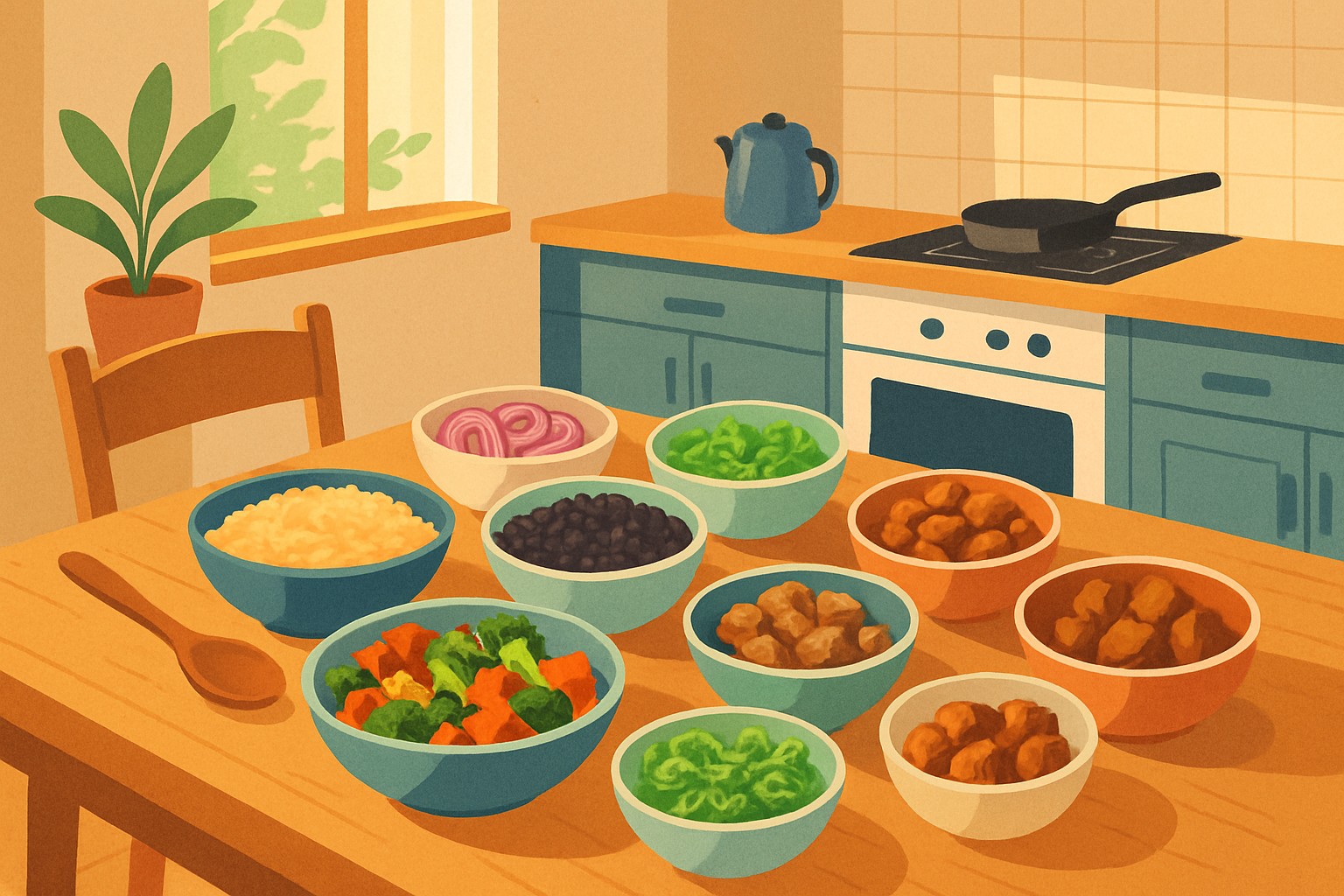
The Universal Meal Formula: Base + Protein + Vegetables + Sauce + Toppings.
Everything up to Protein is shared. The protein is where paths diverge, briefly. The sauce and toppings snap everything back together. You’re cooking one meal with one customizable component. In practice, that’s the difference between 45 minutes and 90 minutes most weeknights.
Here’s how it actually plays out. You make a big pot of seasoned rice or roasted sweet potato. You roast a sheet pan of vegetables with olive oil, smoked paprika, and salt. You make a sauce — tahini, salsa verde, a soy-ginger glaze, anything. While the vegetables roast, you warm black beans on one burner and cook chicken sausage on another. The table assembles their own bowl.
The key insight behind the formula: as Lindsay S. Nixon of Happy Herbivore has observed, “most people are pretty timid about trying something new, so serve up a dish they already know and love.” The modular system uses familiar formats (bowls, tacos, pasta) as the delivery vehicle, which removes the need for anyone to “try” something unfamiliar. Meat eaters add their protein to something that already looks and smells like food they recognize. Nobody feels served a substitution.
The other thing the formula eliminates: meat-substitute purchases. Processed vegan substitutes are expensive, inconsistent in quality, and often the thing that signals to a resistant dinner table that this is a “vegan meal.” Beans, lentils, chickpeas, and tofu are cheaper, hold their texture better in sauces, and don’t read as a replacement. They read as food.
Five Vegan Meal Formats That Work for Meat Eaters Every Time
The Universal Meal Formula works inside any of five formats. These aren’t recipes so much as structural templates; once you have the template, you’re improvising, not following instructions.
Tacos and burritos
The base is already implied: tortillas. The vegetables go into a shared roasted mix (peppers, onion, corn, zucchini). The sauce — chipotle crema, avocado, salsa — is shared. The protein splits: seasoned black beans or pinto beans on one side, carnitas or ground beef on the other. Toppings (cilantro, pickled jalapeños, lime) unify everything. One setup, each person builds their own.
For small households, this scales cleanly to two people: one can of beans yields three or four servings. Make it once, eat tacos twice.
Chili
Chili is one of the few formats where the vegan version doesn’t need a protein workaround at all. A chili built on black beans, kidney beans, fire-roasted tomatoes, cumin, smoked paprika, chipotle in adobo, and dark chocolate (half a square — trust the process) is genuinely satisfying to people who eat meat. The depth of flavor comes from the spice combination and umami stacking, not from animal protein.
If someone at the table wants meat in theirs, cook ground beef separately, season it the same way, and let them stir it into their bowl. The vegan chili base doesn’t require their participation.
And this is also the format with the best small-household math. A pot of chili yields six to eight servings. Freeze half immediately in two-serving containers.
Pasta
The shared base is obvious. The sauce is where you make or break it. A tomato sauce with lentils, mushrooms, and a tablespoon of soy sauce or miso has a savory depth that reads as substantial to people who expect meat in their pasta. Mushrooms especially bring glutamate-driven umami that closes most of the flavor gap.
For meat eaters, the adaptation is simple: brown Italian sausage, set it aside, stir it into individual portions. The sauce stays vegan. Nobody is eating something they didn’t want.
Stir-fry
Base: rice or noodles. Sauce: something built from soy, ginger, garlic, and a fat (sesame oil or peanut butter). Vegetables: whatever needs to be used. Protein split: tofu on one side of the wok, chicken or shrimp on the other. Combine with shared sauce and vegetables at the end.
Stir-fry is also the format with the fastest execution. From cold kitchen to plated food: 25 minutes if your mise en place is tight.
Grain bowls
The most flexible format and the easiest to scale for one person. Farro, quinoa, or brown rice as the base. Whatever vegetables you have. A protein — any legume, or marinated tofu if you want texture contrast. A dressing. Grain bowls accommodate leftovers from other modular meals, so they’re also the solution to small-household waste.
Vegan Meal Prep for One or Two: The Small-Household Logistics Fix
The average US household wastes $1,866 per year on discarded groceries. For a one- or two-person household eating partially vegan, that number climbs fast if you’re buying a bunch of cilantro for one recipe and a head of red cabbage that sits in the crisper until it’s amber.
The logistics fix matters more than any individual recipe.
The 2x4 Framework: Choose two base recipes per week, each yielding four servings. That’s eight meals. In a two-person household eating together, two recipes covers most of the week with one or two nights of freestyle or restaurant meals. In a one-person household, it covers the full week with a couple of days of frozen backup.
The ingredient overlap rule: your two weekly recipes should share at least two or three ingredients. If recipe one uses a can of coconut milk and recipe two also uses coconut milk, you buy one full can and split it. If recipe one uses cilantro and recipe two doesn’t, you’re buying a bunch of cilantro for two tablespoons and throwing away the rest.
Practical pairings that work well together:
- Lentil chili (week’s dinners) + lentil soup (week’s lunches). Same protein base, different flavor profile, one bag of lentils.
- Black bean tacos (dinners) + grain bowls using taco leftover components (lunches).
- Chickpea tikka masala (dinners) + chickpea salad sandwiches from leftovers (lunches).
Freeze half, immediately. The biggest small-household trap is making a full batch, eating from it for three days, and watching the last two servings slowly become inedible in the back of the fridge. The fix: when the pot is done, portion half into containers and freeze before you eat the first serving. You’re building a library of ready meals, not managing leftovers.
Buy dried lentils and beans in 2-pound bags minimum. They’re shelf-stable for a year, cost a fraction of canned per serving, and the cooking process is passive (soak overnight, simmer while you work). A two-pound bag of green lentils produces roughly 14 half-cup servings of cooked lentils. At roughly $2–3 per bag, you’re paying almost nothing per meal for protein.
The Vegan Nutrition Checklist: What “Appropriately Planned” Actually Means
What nutrients do vegans need to track? The evidence points to six key areas: iodine, vitamin B12, iron, omega-3 fatty acids (EPA and DHA), calcium, and vitamin D. Each has a specific gap mechanism and a specific fix — supplementation, fortified foods, or cooking strategy. Getting all six right is what separates “eating plants” from an appropriately planned vegan diet.
The AND 2025 position paper is real good news. Vegan diets, planned correctly, are nutritionally adequate for non-pregnant adults. But the qualifier matters more than the headline.
A 2023 analysis published in Cureus by Graham and colleagues examined the Forks Over Knives meal plan, widely considered a model of careful plant-based eating. Their finding: the plan was deficient in ten nutrients. Iodine came in at 1% of the daily value. Vitamin D at 5%. Calcium at 58%. Choline at 30%.
That’s not an indictment of vegan diets. It’s an argument that “eating plants” and “appropriately planned vegan diet” are not the same thing. The gap between them is specific and addressable.
Here’s what the evidence says you actually need to track.
Iodine: the most skipped nutrient on the list
Iodine is the most overlooked nutrient in vegan diets, and the Cureus finding makes the stakes clear. Seaweed is the only substantial whole-food plant source, and its iodine content varies so wildly by species and harvest that it can’t be relied on as a consistent source. Or rather, it can be eaten regularly — it just can’t be counted on for consistent dosing.
The practical solution is simple: use iodized salt in your cooking. Iodized salt is inexpensive, available everywhere, and contains enough iodine to meet daily needs at normal cooking quantities. If you’re using specialty salts (kosher, sea salt, pink Himalayan) for texture or flavor, most are not iodized. Use iodized table salt for cooking even if you finish dishes with another salt.
If you don’t use much added salt, a vegan multivitamin that includes iodine covers the gap. Not all do; check the label before you buy.
B12: the non-optional supplement
The NIH puts the adult B12 RDA at 2.4 micrograms per day, and vegans are explicitly a high-risk group for deficiency because B12 occurs naturally only in animal foods. The Quadram Institute’s research has found deficiency rates up to 40% in vegetarian populations and higher still in unsupplemented vegans.
Supplementation isn’t optional. But the good news: B12 is one of the least expensive supplements on the market, it has no known toxicity ceiling at standard doses, and it works. Fortified foods (nutritional yeast, plant milks, some cereals) help but aren’t reliably consistent enough to be your only source.
A daily B12 supplement or a weekly high-dose supplement (some people prefer once-weekly for convenience) are the two standard approaches. Talk to your doctor or a registered dietitian for specific dosing, particularly if you have any history of absorption issues.
→ Check current prices on Amazon for B12 supplements
Iron: the math is different for you
Vegan and vegetarian sources of iron are non-heme iron, which the body absorbs less efficiently than heme iron from meat. The Frontiers in Nutrition 2023 guidance for vegan iron RDA reflects this: 32 mg per day for women, 14 mg per day for men. Those are nearly double the standard RDA for omnivores.
Good plant sources: lentils, tofu, tempeh, pumpkin seeds, white beans, fortified cereals, blackstrap molasses. The key pairing: consume iron-rich foods with vitamin C sources (bell peppers, broccoli, citrus, strawberries) to improve absorption meaningfully. Avoid coffee or tea immediately before or after iron-rich meals; tannins inhibit absorption.
Get your iron levels checked periodically, especially if you’re menstruating. A serum ferritin test (not just hemoglobin) gives a more complete picture. Worth an annual blood panel conversation with your doctor.
Omega-3: the conversion problem
The NIH Office of Dietary Supplements is straightforward about this: ALA — the omega-3 in flaxseed, walnuts, and chia — can convert to EPA and DHA, but the conversion rate is very limited, with reported rates of less than 15%. Research published in Frontiers in Nutrition (2023) puts the DHA-specific conversion at less than 1%. EPA and DHA are the forms research links to cardiovascular and cognitive benefits.
Eating walnuts and flaxseed is still valuable. But relying on ALA conversion alone to meet EPA and DHA needs isn’t reliable.
The solution that sidesteps the conversion problem: algae-based omega-3 supplements. Algae is the original source of DHA and EPA; fish contain it because they eat algae. Algae oil gives you the same final product without the fish. This is one area where supplementation fills a gap that food alone can’t reliably close.
→ Check current prices on Amazon for algae omega-3 supplements
Calcium: present, but check the math
Calcium is findable in plant foods (fortified plant milk, tofu set with calcium sulfate, kale, bok choy, white beans, almonds), and a well-organized vegan diet can hit the RDA through food alone. The Cureus finding — that the Forks Over Knives plan came in at 58% of the daily value — is a reminder to actually count, not assume.
Two cups of fortified plant milk per day gets you most of the way there. Tofu made with calcium sulfate (check the label; not all tofu uses this coagulant) and leafy greens round it out.
Vitamin D: not a vegan-specific problem, but still your problem
Most people in northern latitudes are low on vitamin D year-round regardless of diet. For vegans, D3 from animal sources isn’t an option; look for vegan D3 derived from lichen, or D2 (plant-derived but slightly less bioavailable). Fortified plant milks and cereals help. A supplement is the reliable backup.
Supplements and Fortified Foods: What to Actually Buy
The practical shopping list is shorter than the nutrient list suggests.
Iodized salt: Already in your kitchen, or should be. Swap at least one of your salts for iodized. Morton and Diamond Crystal both make iodized versions. This costs nothing extra.
B12 supplement: Look for methylcobalamin (the active form) rather than cyanocobalamin if you want the more bioavailable version, though cyanocobalamin works for most people. A standard daily dose in the 500–1000 mcg range (the higher amount compensates for absorption variability) is common, but confirm specifics with a healthcare provider.
→ Check current prices on Amazon for vegan B12 methylcobalamin
Algae omega-3: Look for a product that specifies both DHA and EPA content, not just total omega-3. Products with at least 250 mg DHA per serving are typical for daily maintenance, though confirm specific dosing with your doctor or a registered dietitian.
→ Check current prices on Amazon for vegan algae omega-3 DHA EPA
A vegan multivitamin: A multi that includes iodine, D3 (lichen-sourced), and B12 can simplify the supplement stack significantly. Not all vegan multivitamins include iodine — worth checking specifically before you buy.
→ Check current prices on Amazon for vegan multivitamin with iodine
The medical consultation note: A blood panel that includes B12, ferritin (iron stores), and vitamin D is worth requesting from your doctor annually, particularly in the first year or two of eating vegan. Symptoms of deficiency can be subtle and slow-developing. The panel tells you whether your system is working before problems become significant.
No supplement brand names here should be taken as medical endorsement. Recommendations are category-level; specific brands and doses should be confirmed with your doctor or a registered dietitian.
Putting It Together: A Week of Vegan Cooking in the Mixed Household
Here’s how both systems run simultaneously in a realistic week for a one- or two-person household where one person eats vegan.
Sunday: Batch cook day. Make a large pot of lentil chili (six servings). Freeze three servings immediately. Prep a grain base (farro or brown rice) for the week. Hard-boil a few eggs if the meat eater wants protein for quick meals; these don’t require your involvement. Take your B12 supplement and algae omega-3 with lunch.
Monday dinner: Modular tacos. Roasted peppers and onions on a sheet pan (shared). Black beans from a can, seasoned with cumin and lime (yours). Ground beef or chicken in a skillet for whoever wants it. Tortillas, salsa, avocado on the table. Five to seven minutes of actual active cooking beyond the oven work.
Tuesday dinner: Lentil chili from the batch. This is a no-cook night. Reheat, add cornbread if you want it, done in 12 minutes. The meat eater can add shredded rotisserie chicken to their bowl if they want it.
Wednesday dinner: Pasta. Sauce built from canned tomatoes, lentils, mushrooms, a tablespoon of soy sauce. Spaghetti. Parmesan on the table for whoever wants it. Cook Italian sausage on the side for the meat eater; they stir it in themselves.
Thursday: Leftover pasta becomes lunch. If grain bowl ingredients are still in the fridge, build a quick bowl rather than buying out.
Friday dinner: Stir-fry. Rice from the batch cook. Broccoli, snap peas, bell peppers in the wok. Tofu (pressed and cubed, seasoned with the sauce) on your side. Shrimp or chicken on theirs. Shared soy-ginger sauce brings it together.
Saturday: Flex day. Use any remaining chili. Build grain bowls from whatever’s left in the fridge. Order out if the week’s been heavy.
The nutritional rhythm runs quietly in parallel the whole time: iodized salt is already in everything. The supplements take thirty seconds with breakfast. A fortified plant milk in your coffee or oatmeal covers calcium and D3.
None of this is dramatic. Successful vegan cooking for meat eaters isn’t about separate menus or elaborate substitutions — it’s about a structure that absorbs the difference without making a production of it. “Appropriately planned” doesn’t mean obsessive — it means accounted for. Once you’ve done the accounting and built the habits, the whole system fades into the background of a normal week. Which is exactly where it belongs.
Sources
-
Academy of Nutrition and Dietetics, “Position of the Academy of Nutrition and Dietetics: Vegetarian and Vegan Diets,” Journal of the Academy of Nutrition and Dietetics, February 2025. https://pubmed.ncbi.nlm.nih.gov/39923894/
-
Graham et al., “Nutrient Deficiencies in Plant-Based Diets: A Comparison of a Whole-Food Plant-Based Meal Plan with Dietary Reference Intakes,” Cureus, 2023. https://pmc.ncbi.nlm.nih.gov/articles/PMC10159689/
-
NIH Office of Dietary Supplements, “Vitamin B12: Fact Sheet for Health Professionals.” https://ods.od.nih.gov/factsheets/VitaminB12-HealthProfessional/
-
NIH Office of Dietary Supplements, “Omega-3 Fatty Acids: Fact Sheet for Health Professionals.” https://ods.od.nih.gov/factsheets/Omega3FattyAcids-HealthProfessional/
-
Haider et al., “Micronutrient Status in Vegetarians and Vegans,” Frontiers in Nutrition, 2023. https://pmc.ncbi.nlm.nih.gov/articles/PMC10665534/
-
Quadram Institute, “How to Get Enough Iron and Vitamin B12 as a Vegetarian or Vegan.” https://quadram.ac.uk/blogs/how-to-get-enough-iron-and-vitamin-b12-as-a-vegetarian-or-vegan/
-
Lindsay S. Nixon, “Vegan Recipes for Meat-Eaters,” Happy Herbivore, 2013. https://happyherbivore.com/2013/08/vegan-recipes-for-meat-eaters/
-
Vegetarian Resource Group, “Cooking Tips for Vegans and Vegetarians,” Vegetarian Journal, 2024, Issue 3. https://www.vrg.org/journal/vj2024issue3/2024_issue3_cooking_tips.php